Running an e-commerce business involves much more than selling products through an online storefront. Businesses need to attract visitors, convert shoppers, manage customer relationships, and follow up with prospects. Encouraging repeat purchases and keeping marketing activities connected to sales data. When these tasks are handled across disconnected platforms, valuable customer information can become difficult to use.
This is where having Shopify integrated with GoHighLevel can make a difference. Shopify provides the foundation for running an online store. While GoHighLevel brings customer management, workflows, communication, and marketing automation into the same environment.
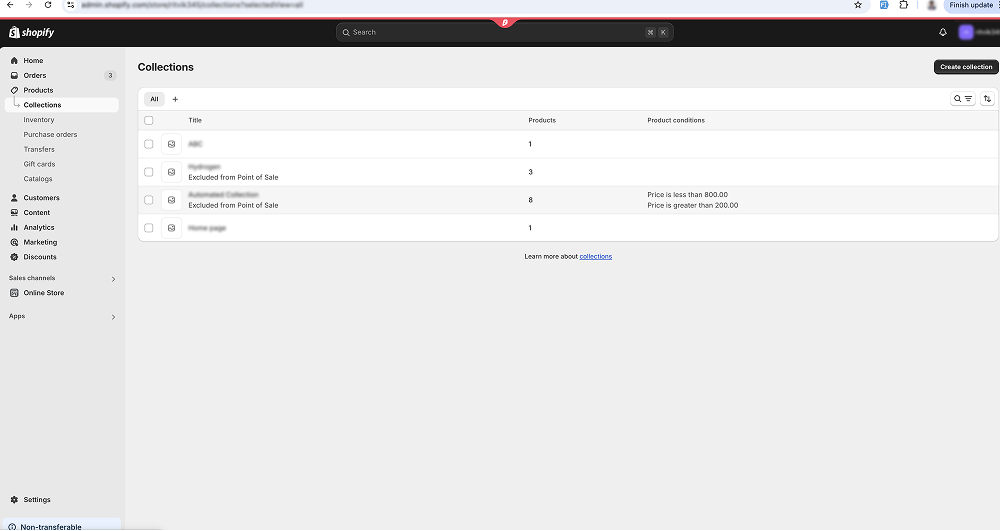
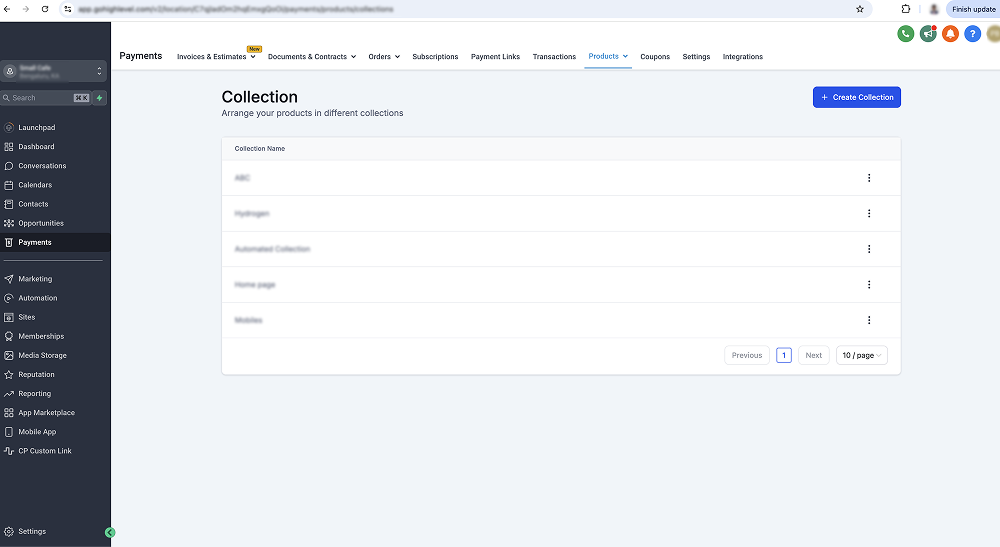
HighLevel's current Shopify integration can import and sync supported data. Including products, collections, contacts, orders, and transactions. It also allows selected Shopify activity to be used for ecommerce workflows and customer follow-up.
For businesses looking to improve their customer journey without constantly switching between systems. This combination offers a practical way to connect storefront activity with marketing and sales processes.
Overview of Shopify and GoHighLevel
Shopify is one of the most widely used platforms for building and managing online stores. It gives businesses the infrastructure needed to create product catalogs, process orders, manage customers, track inventory, and operate an e-commerce storefront.
For Shopify for small business users, the platform can provide a relatively accessible way to establish an online sales channel without building an entire commerce system from scratch.
GoHighLevel, on the other hand, focuses heavily on CRM, communication, sales pipelines, workflows, lead management, and marketing automation. Its GoHighLevel features allow businesses to build automated customer journeys around interactions and events.
The two platforms therefore serve different but complementary purposes. Shopify manages the commerce side of the business. While GoHighLevel can help businesses act on customer and order information through marketing and follow-up workflows.
Importance of Integration for E-commerce
Customers rarely follow a simple path from discovering a product to making a purchase. Someone may visit a store, browse several products, leave without purchasing, return days later, complete an order, and eventually become a repeat customer.
Without connected systems, each interaction can exist in isolation.
Integration allows businesses to connect with these activities. For example, Shopify order information can become part of a customer's broader record in GoHighLevel. Allowing the business to create follow-up campaigns based on purchase activity.
HighLevel currently supports historical imports and ongoing sync options for products, collections, contacts, orders, and transactions.
Instead of simply collecting transaction data, businesses can use that information to make their customer communication more relevant.

Benefits of Shopify Integrated with GoHighLevel
The biggest advantage of connecting the two platforms is the ability to bring commerce data closer to marketing and customer relationship activities.
A Shopify customer who completes an order, for example, does not have to remain simply an entry in an order database. Their activity can become part of a broader customer journey involving post-purchase communication, product education, review requests, cross-selling, or future promotions.
HighLevel's integration also supports historical data import and selected ongoing synchronization. This means businesses can work with existing Shopify information while building processes around new customer activity.
The result can be a more coordinated approach to ecommerce automation, where customer actions help determine what happens next.
Streamlining Shopify Inventory Management
Shopify remains the primary system for managing store inventory. Shopify's own inventory tools allow businesses to track stock quantities, adjust inventory, manage locations, and review inventory history.
This distinction is important when discussing Shopify integrated with GoHighLevel. The integration should not be viewed as replacing Shopify's inventory management capabilities. Instead, it can connect supported product and commerce information with the customer engagement and automation capabilities available in HighLevel.
For example, a business can keep inventory operations inside Shopify while using GoHighLevel to manage customer communication around purchases.
This separation can be useful. The store team can continue managing products and stock in Shopify. While the marketing team can use customer and order activity to build campaigns and follow-up workflows.
Businesses operating multiple locations or handling large product catalogs should still evaluate their Shopify inventory configuration separately. Shopify supports inventory tracking, stock adjustments, inventory transfers, and related inventory workflows within its own platform.
Enhancing Ecommerce Marketing Tools
Many ecommerce businesses use several ecommerce marketing tools for email, customer segmentation, CRM, lead management, appointment scheduling, and campaign automation.
The challenge is not having enough tools. It is making those tools work together.
GoHighLevel can bring CRM and marketing activities into a central environment. When Shopify data is connected, businesses can use supported customer and order activity to inform follow-up.
For example, a business could build a workflow that sends a post-purchase message after an order event. Followed by educational content and a later cross-sell campaign.
This gives marketers more opportunities to create customer journeys based on actual behavior rather than generic mailing lists.
Features of GoHighLevel
The value of the integration becomes clearer when Shopify data is combined with relevant GoHighLevel features.
Depending on the business setup and subscription, HighLevel can provide capabilities around CRM, workflows, conversations, sales pipelines, forms, calendars, email and SMS communication, reporting, and automation.
For an e-commerce business, these capabilities can support processes such as:
- Customer segmentation based on purchase activity
- Automated post-purchase communication
- Lead nurturing
- Follow-up campaigns
- Re-engagement workflows
- Sales pipeline management
- Email and SMS marketing
- Customer communication tracking
- Automated notifications
- Campaign performance monitoring
HighLevel's Shopify integration also provides options for importing historical records and configuring ongoing synchronization.
The exact workflow design should depend on the store's sales process, customer lifecycle, and marketing goals.
Marketing Automation for E-commerce
Marketing automation for ecommerce becomes more useful when it responds to customer behavior.
Consider an abandoned checkout scenario. A potential customer adds products to their shopping journey but does not complete the purchase. Instead of relying on a generic promotional email sent days later, an automated workflow can be designed around the relevant ecommerce event.
Similarly, after an order is submitted, the business can create a post-purchase sequence that provides useful information, encourages engagement, and introduces relevant products at an appropriate time.
HighLevel's current documentation states that connected Shopify activity can support ecommerce-related automation. Recommending using newer ecommerce abandoned-checkout triggers when creating new abandoned-checkout workflows.
This is one of the main reasons ecommerce automation matters: it turns customer activity into a signal for the next marketing action.
Practical Use Cases
There are several ways an online store can use Shopify and GoHighLevel together.
Abandoned Checkout Follow-Up
A shopper starts the buying process but does not finish. The business can create an automated follow-up sequence designed to bring the customer back to the purchase.
Post-Purchase Engagement
Once a customer places an order, the business can send relevant follow-up communication. Such as product guidance, customer support information, review requests, or complementary product recommendations.
Repeat Purchase Campaigns
For products that customers purchase regularly, order history can help businesses create campaigns aimed at bringing previous customers back when they are likely to need another product.
Customer Segmentation
Customer and order information can support more targeted communication. Rather than sending identical promotions to everyone, businesses can create different campaigns based on customer behavior and purchase history.
Re-Engagement
Customers who have not purchased recently can become part of a re-engagement workflow designed to bring them back to the store.
These examples demonstrate how integration can move an ecommerce business from one-off campaigns toward ongoing customer journeys.
Small Businesses Leveraging Integration
Small businesses often have limited marketing teams, making automation particularly valuable.
A growing Shopify store may start with one person handling product management, customer communication, marketing, and sales. As the customer base grows, manually following up with every shopper becomes increasingly difficult.
Connecting Shopify with GoHighLevel can help create repeatable processes.
For example, a small fashion retailer could use Shopify to manage products and orders. While using HighLevel to organize customer communication. A customer who purchases a product could enter a post-purchase workflow, receive relevant messages, and later become eligible for a repeat-purchase campaign.
The objective is not to automate every customer interaction. Instead, automation can handle predictable activities. While the team focuses on conversations and decisions that require human attention.
What does a Successful Implementation Looks Like
1. Fashion Store: Recovering Abandoned Checkouts
The situation:
A Shopify fashion store was getting consistent traffic, but many shoppers were leaving after entering their email and adding products to checkout. The store relied mainly on Shopify's standard abandoned cart emails.
The GoHighLevel solution:
Shopify customer and checkout activity connected to GoHighLevel. An abandoned-checkout workflow was created to:
- Send an email shortly after abandonment
- Follow up with a second message the next day
- Segment customers based on cart value and products
- Remove customers from the recovery sequence once they purchased
- Add previous buyers to separate upsell campaigns
HighLevel now has an Abandoned Checkout trigger that can work with connected external stores such as Shopify.
Result:
Instead of treating every abandoned checkout the same way, the store could automatically personalize follow-ups and continue nurturing shoppers who did not purchase immediately.
Why it matters:
The biggest improvement isn't simply sending another email. It's turning an abandoned checkout into a CRM event that can trigger a broader customer journey.
2. Home Decor Store: Building High-Value Customer Segments
The situation:
A Shopify home decor store sells products ranging from inexpensive accessories to high-ticket furniture. Sending the same marketing message to every customer was producing weak engagement.
The GoHighLevel solution:
Shopify order data was used to organize customers into different segments:
| Customer Segment | Automation |
| First-time buyer | Welcome + education sequence |
| Repeat buyer | Loyalty/upsell campaign |
| High-value customer | VIP offers |
| No purchase in 90 days | Win-back campaign |
| Purchased Product A | Complementary Product B campaign |
Instead of simply asking, “Who is on our email list?”, the business could ask, “What has this customer purchased and what should we offer them next?”
Result:
Marketing became more relevant because campaigns were based on actual purchase behavior, rather than a generic subscriber list.
How to Get Started
Before connecting the platforms, define what you want the integration to accomplish.
Start by identifying the customer journeys that currently require the most manual work. These might include abandoned checkouts, post-purchase communication, lead follow-up, repeat-purchase campaigns, or customer segmentation.
Then determine which Shopify data needs to be available in HighLevel.
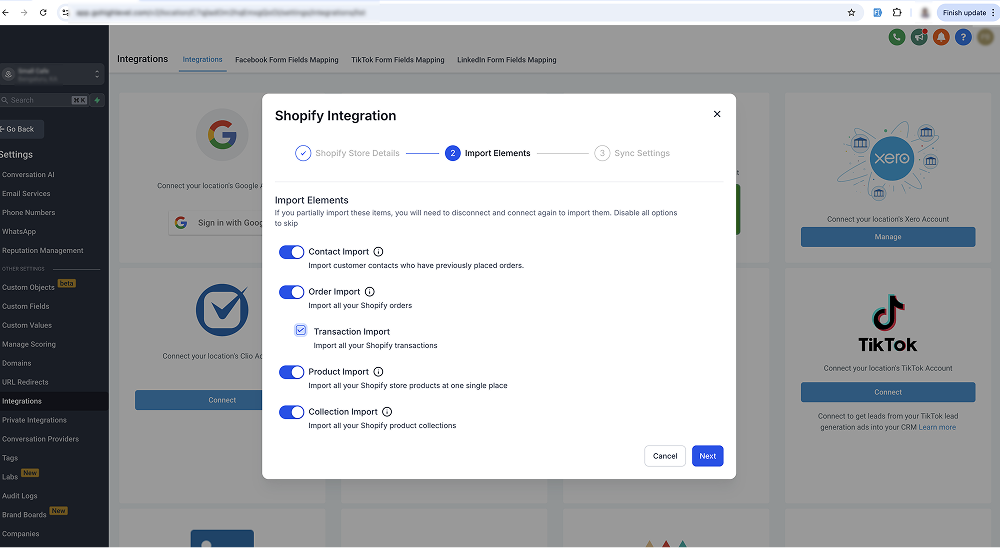
HighLevel's current setup provides separate choices for historical imports and ongoing sync. Supported import options include contacts, orders, transactions, products, and collections, while ongoing settings can include contact, order, transaction, product, and collection sync, along with relevant triggers.
This distinction matters because importing historical data and synchronizing future activity are separate parts of the setup.
Steps to Integrate Shopify with GoHighLevel
So, does Go High Level integrate with Shopify? Yes. HighLevel currently provides a Shopify integration that allows supported Shopify data to be imported and synchronized with a HighLevel sub-account.
The current setup process is generally:
1. Open the relevant HighLevel sub-account.
2. Go to Settings > Integrations > Shopify.
3. Select Connect.
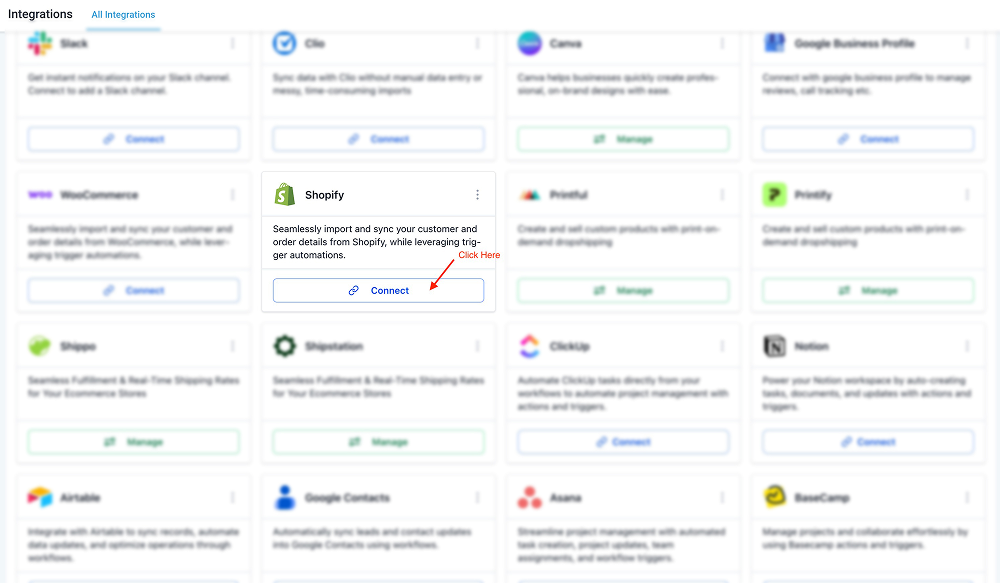
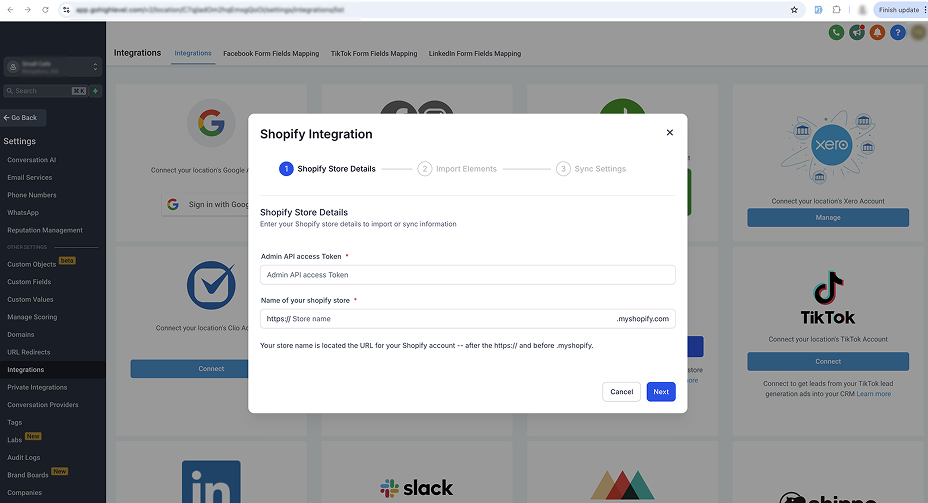
4. Enter the Shopify store name or URL.
5. Select the Shopify data you want to import.
6. Configure the data and triggers you want to synchronize going forward.
7. Save the settings and complete Shopify's authorization process.
8. Review the imported information and test the relevant workflows.
HighLevel's current Shopify connection uses an OAuth-based app flow for new connections. Reducing the need for the older manual custom-app and API-token setup. Existing legacy connections may continue working unless they are disconnected.
After the connection is active, businesses should test customer records, orders, product information, triggers, and workflows before relying on the system for important campaigns.
Hiring a GoHighLevel Developer
While the basic connection can be configured through the available integration, complex ecommerce operations may require additional technical work.
Businesses may want to hire GoHighLevel developer support when they need custom workflows, advanced automation, data mapping, troubleshooting, migration assistance, or integrations with other business systems.
A developer can also help review the existing Shopify setup. Determining which processes should remain in Shopify and which should be handled through GHL.
This becomes especially useful when the business has a large customer database, multiple automation paths, complex segmentation requirements, or several third-party systems.
When you hire GHL developer services, look for experience with both GoHighLevel workflows and ecommerce operations rather than choosing someone based only on familiarity with the platform.
Finding Reliable GHL Agencies
For businesses that need ongoing support rather than a one-time technical task, working with GHL agencies can be a better fit.
A capable agency should be able to understand the commercial goal behind integration. The conversation should cover questions such as:
- Which Shopify events need to trigger automation?
- Which customer segments matter most?
- What should happen after a purchase?
- Which systems need to exchange data?
- What should remain inside Shopify?
- What should be managed in HighLevel?
- How will workflows be tested and monitored?
A reliable GoHighLevel agency should also explain the limitations of the native integration rather than promising that every Shopify function will automatically appear inside HighLevel.
HighLevel's migration documentation notes that while supported ecommerce data can be imported and synchronized, other areas such as workflows, store pages, payment settings, and team processes may require review or manual rebuilding during a broader migration.
That makes technical planning an important part of any larger implementation.
Future of E-commerce with Integrated Solutions
E-commerce is moving toward systems where customer data, commerce activity, and marketing workflows are increasingly connected.
The goal is not necessarily to replace every tool with one platform. Instead, businesses are looking for better ways to make their existing systems work together.
A Shopify store can remain in the central commerce environment while GoHighLevel becomes an important layer for CRM, customer communication, segmentation, and automation.
As businesses collect more customer interaction data, the ability to turn that information into timely actions will become increasingly valuable. Ecommerce automation can help companies respond faster while reducing repetitive manual tasks.
The Conclusion
Shopify and GoHighLevel can serve different roles within the same e-commerce strategy. Shopify provides the storefront, product, order, and inventory infrastructure, while HighLevel can help businesses organize customer relationships and build marketing workflows around supported ecommerce activity.
The real value of Shopify integrated with GoHighLevel comes from connecting customer behavior with the actions a business takes next.
From abandoned-checkout follow-ups and post-purchase campaigns to customer segmentation and repeat-purchase marketing, the integration creates more opportunities to build structured customer journeys.
For businesses considering the setup, the best approach is to start with specific goals, identify the data and workflows required, test the connection carefully, and bring in a qualified GoHighLevel developer when the project requires custom implementation.
With the right strategy, Shopify and GoHighLevel can become more than two separate platforms. Together, they can provide a connected foundation for customer engagement, marketing automation, and long-term ecommerce growth.
About the Author